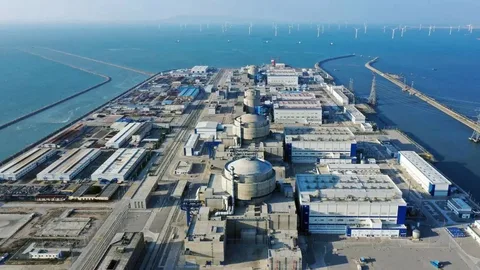
As the world races to decarbonize its energy systems and meet the surging electricity demands of the digital age, one company has quietly emerged as a defining force in the global nuclear landscape: China National Nuclear Power Co., Ltd., better known as CNNP. Founded in 2008 and headquartered in Beijing, CNNP has grown from a domestic energy operator into a strategic cornerstone of China’s clean energy ambitions — and increasingly, a global player with ambitions that extend far beyond its borders.
With nuclear power at the center of China’s carbon neutrality pledge and the explosive growth of AI data centers demanding unprecedented energy supply, CNNP finds itself at the intersection of two of the most consequential trends of our era.
What Is CNNP?
CNNP (China National Nuclear Power Co., Ltd.) is a publicly listed subsidiary of China National Nuclear Corporation (CNNC), one of the world’s largest nuclear energy conglomerates. The company specializes in the full lifecycle of nuclear power — from investment, development, and construction to operation, maintenance, and technical services. Beyond nuclear energy, CNNP also manages clean energy projects including wind and solar power, as well as power transmission and distribution.
As of the end of 2024, CNNP operated 25 nuclear power units with an installed capacity of 23.75 million kilowatts, alongside solar and wind power units with a combined installed capacity of nearly 30 million kilowatts. Its portfolio includes well-known facilities such as Qinshan Nuclear Power, Jiangsu Nuclear Power, and Fuqing Nuclear Power — plants that together form the backbone of China’s civilian nuclear output.
Financially, CNNP commands significant scale. As of mid-2025, the company’s market capitalization reached $26.4 billion, with trailing twelve-month revenue totaling $11 billion. It has maintained a consistent ‘A’ rating from China’s State-owned Assets Supervision and Administration Commission (SASAC) for 18 consecutive years — a testament to its financial stability and operational discipline.
Technological Leadership: Hualong One and Linglong One
At the heart of CNNP’s competitive advantage lies its technological edge. The company has been instrumental in developing and deploying the Hualong One (HPR1000) reactor — China’s independently designed third-generation pressurized water reactor (PWR) that has become a benchmark for modern nuclear construction.
The Hualong One completed its first unit in just 68.7 months, making it the only third-generation nuclear project delivered on schedule globally. Its demonstration units scored a perfect 100 in evaluations by the World Association of Nuclear Operators (WANO), underscoring its exceptional safety and reliability. Today, a total of 41 Hualong One units have been approved, are under construction, or are already in operation worldwide — a remarkable achievement for a domestically developed reactor design.
Beyond the Hualong One, CNNP is pioneering the next frontier of nuclear innovation: Small Modular Reactors (SMRs). The company’s Linglong One (ACP100) became the world’s first commercial SMR to receive approval from the International Atomic Energy Agency (IAEA), with the project slated for completion in 2026. This positions CNNP at the forefront of a technology that many experts believe will reshape distributed energy systems globally.
By 2024, China achieved 100% domestic sourcing for all key nuclear power equipment — a milestone that reduces foreign technology dependency and significantly enhances cost-effectiveness and supply chain resilience.
CNNP and the AI Energy Nexus
Perhaps no development has elevated CNNP’s strategic importance more than the explosive growth of artificial intelligence. According to International Energy Agency forecasts, global IT loads are expected to see a cumulative increase of 106 gigawatts between 2025 and 2030, driven by the rapid expansion of generative AI and large-scale model training.
Lu Tiezhong, chairman of CNNP, has been vocal about nuclear power’s unique suitability for this challenge. Unlike intermittent energy sources that fluctuate with weather conditions, nuclear plants offer stable, continuous baseload power necessary to prevent interruptions in critical computing processes. As Lu noted, nuclear power is “uniquely positioned to support high-load, nonstop facilities such as AI data centers.”
The relationship, however, is reciprocal. CNNP itself has embraced AI to enhance its own operations. The company’s Sanmen Nuclear Power Plant — a subsidiary of CNNP — was officially recognized as a “Lighthouse Factory” by the World Economic Forum, becoming the first nuclear facility in the world to receive this designation. The plant has implemented over 40 digital applications, resulting in a 1.5% improvement in unit efficiency and nearly a 50% reduction in major overhaul costs.
Additionally, China Nuclear Power Operation Technology Corporation has integrated the DeepSeek AI platform into its operations, improving data analysis and response efficiency by 40 to 50%. Advanced robotics developed by CNNC are now being used for reactor refueling, underwater inspection, and non-destructive testing in high-radiation environments — enhancing both safety and operational efficiency.
Expansion at Home and Abroad
China’s nuclear expansion is accelerating at a pace unmatched anywhere in the world. In 2024, 11 new reactors were added with approval for five new projects. This momentum continued into 2025, with state approval granted for 10 more reactors across five major projects, representing an investment exceeding 200 billion yuan. CNNP aims for 65 million kilowatts of operational capacity by the end of 2025, 110 million kilowatts by 2030, and a long-term target of 200 GW by 2035.
One of the most innovative recent projects is the Xuwei nuclear power project in Jiangsu province, where first concrete was poured in January 2026. The plant will supply both industrial heating and electricity by coupling a high-temperature gas-cooled reactor (HTGR) with two Hualong One pressurized water reactors — described as the “world’s first dual-coupling demonstration project” combining third-generation and fourth-generation nuclear technologies.
On the international stage, CNNP is actively expanding its footprint. The Hualong One has been positioned as a replicable solution for countries participating in China’s Belt and Road Initiative, offering developing nations a proven, affordable, and clean energy pathway. Construction of a Hualong One unit has already begun at Pakistan’s Chasnupp-5 nuclear power plant, and CNNP’s chairman has emphasized that the sector is already expanding its overseas market with the goal of contributing a Chinese solution to the global energy transition.
Safety, Sustainability, and Public Engagement
Safety is not merely a regulatory requirement for CNNP — it is a foundational brand value. The company’s reactor fleet has ranked first globally in safety performance for eight consecutive years, with more than 300 reactor-years of safe operation on record.
On the environmental front, CNNP’s 26 operating units have cumulatively generated 1.9 trillion kilowatt-hours of electricity — an output equivalent to avoiding 1.51 billion metric tons of carbon dioxide emissions, or planting 5.2 million hectares of forest. The company is also integrating nuclear power with renewables, including the 2 GW Tianwan tidal flat solar demonstration project, the nation’s largest offshore solar farm, located in eastern Jiangsu province.
CNNP has also invested heavily in public outreach and scientific literacy. Its “Appealing Light” science campaign has run for 13 years, engaging over 6 million participants nationwide. In 2025, the company unveiled a refreshed brand identity built on four core values: “Credible,” “Nice,” “Net-Zero,” and “Power” — reflecting its commitment to safe operations, public engagement, and a low-carbon future.
Looking Ahead
China has pledged to achieve carbon neutrality before 2060, and nuclear power is expected to play an increasingly vital role in that transition. With the country on course to become the global leader in operational nuclear capacity by 2030, and with CNNP at the center of that expansion, the company’s trajectory is as ambitious as it is consequential.
From powering AI data centers to exporting reactor technology to emerging economies, CNNP represents a new model of state-directed industrial strategy — one where energy security, technological sovereignty, and climate responsibility converge. As the global energy landscape continues to evolve, CNNP is not just keeping pace. It is helping to define what comes next.
Leave a Reply